



Let’s quote Geoffrey Batchen. Burning with Desire: The Conception of Photography, 1999 :
“A French architect named A. H. E. (Eugène) Hubert, his attention drawn to the claims made by Daguerre in 1835, sent in a sarcastic reply to the same paper titled « M. Daguerre, the camera obscura, and the drawings which make themselves” (published in Journal des Artistes on September 11, 1836). The article reveals a fair amount of knowledge of both the difficulties and the technical requirements of the photographic process on which Daguerre was then working, suggesting that Hubert also had undertaken some experiments in this direction. And indeed he says as much in his text:
The researches which I have made on this subject seven or eight years ago, and of which I have spoken to several chemists and artists, make me think that even if we assume that a substance more sensitive than chloride of silver has been discovered, one would still have great difficulty in obtaining the most perfect of all drawings: for if we assume taking in the camera obscura image of a plaster cast lit up in bright sunshine and set against a dark background, and even if we assume placing the camera obscura and the object to be copied on the same turntable and rotate it according to the sun’s movement in order that the shadows should remain unchanged, and even if we assume that an almost instantaneous discoloration would not be necessary, this would still be a far cry from copying portraits and landscapes, which have by no means the brightness of plaster exposed to sunlight.
I repeat, I so much doubt M. Daguerre’s anticipated results that I find myself almost tempted to announce that I, too, have discovered a process, the possibility of which has recently been questioned in the Journal des Artistes— a process, namely, for obtaining the most perfect of portraits, by means of a chemical composition which fixes them in the mirror at the moment one looks at oneself!
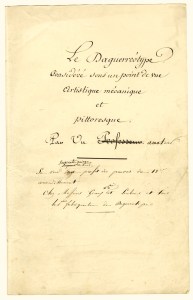
Despite the implied criticisms, Hubert went on to become Daguerre’s main assistant in the latter’s efforts to perfect his metal-based photographic process. In June 1840 (the year of his death), Hubert even published an unsigned pamphlet dedicated to the daguerreotype process, Le Daguerréotype considéré sous un point de vue artistique, mécanique et pittoresque, par un amateur (The Daguerreotype regarded from the viewpoint of art, mechanics and picturesqueness, for the amateur), with a brief final section devoted to paper photography. Interestingly, in this last section he pointed to another Frenchman, Hippolyte Bayard, as the main hope for the future of the difficult paper-based process.”
Reproduction :
